AKG has been making studio microphones for a very long time, and the company’s C-Series includes some of the most recognizable condensers ever made.
The C104 is part of AKG’s newer, more affordable C-Series lineup, aimed at musicians, podcasters, and streamers who want something more serious than a basic USB mic without jumping straight into C414 money.
In this review, I’ll be taking a look at the AKG C104, a fixed-cardioid condenser microphone that seems to replace the older P120 in spirit, though it is not simply the same microphone in a new shell.

Final verdict
For the price, the AKG C104 is a very strong entry-level condenser. It is simple, clean, fairly quiet, and more useful across different sources than I expected from a budget cardioid mic.
It does not offer pads, filters, or multiple polar patterns, so it is not the most flexible microphone in terms of controls. However, the basic sound is well-balanced, with a bright but controlled top end, a firm low end, and a very usable proximity effect.
What I like
- Clean and open sound.
- Excellent value.
- Very good for speech and vocals.
- Controlled low end.
- Simple and easy to use.
What I don’t like
- No pad or low-cut filter.
- Can get a little sharp on bright sources.
Polar pattern and frequency response
The AKG C104 is a cardioid condenser microphone with a 22 mm electret capsule, a frequency response of 20 Hz – 20 kHz, and a transformerless FET circuit.
Although AKG describes it as a large-diaphragm microphone, the 22 mm capsule puts it closer to medium-diaphragm territory. In practice, that is not a bad thing. The C104 still behaves like a side-address studio condenser, but it has a slightly tighter, more controlled feel than some cheaper large-diaphragm mics.
There are no onboard switches here. No pad, no bass roll-off, no polar pattern selector. That keeps the microphone simple, but it also means any filtering or gain management has to happen at the preamp, interface, or DAW stage.
The max SPL is rated at 143 dB, which is very respectable for this price range. Loud vocals, percussion, guitar amps, and even bass-heavy sources are not likely to trouble it unless you are doing something fairly unreasonable.
Self-noise is listed at 14 dB(A), which is not boutique-level quiet, but it is good enough for most studio work, podcasting, streaming, and music recording. I would not worry about it unless you are recording very quiet sources in a very quiet room.
Tonally, the C104 has a modern condenser sound, but thankfully not the brittle version of that. The high end is present and open, with enough lift to help speech and vocals sit forward, but it does not immediately fall into that cheap, glassy harshness that plagues a lot of budget condensers.
The low end is also better behaved than expected. Up close, the proximity effect adds warmth and fullness, but it does not become muddy or bloated too quickly. That makes the C104 especially useful for spoken word and close vocal work.
Vocals 4.7
The C104 works very well as a studio vocal microphone, especially considering the price.
It has enough upper-mid presence to make voices sound clear and direct, but it does not feel overly hyped. On most vocalists, I found it gives a nice balance of articulation and body, with the proximity effect adding some useful warmth when you get closer to the capsule.
It might not be the best choice for singers who already have a very sharp or sibilant voice. In those cases, the upper presence can become a little too noticeable, and I would probably reach for something smoother.
Still, for home studios, demos, pop vocals, backing vocals, and general songwriting work, the C104 is more than capable. Use a pop filter, keep the distance sensible, and it should give you very workable results.
Live vocals
I would not make the C104 my first choice for live vocals, mainly because it is still a condenser and does not have the same stage-friendly rejection and handling behavior as a proper live dynamic mic.
That said, the cardioid pattern is tight enough to make it useful in controlled live sessions, acoustic performances, or video shoots where the room is not too chaotic.
For loud stages, I would still grab an SM58 and move on with my day.
Spoken word
This is probably one of the C104’s strongest applications.
For podcasting, voiceover, streaming, and general speech recording, the C104 sounds full, clear, and professional enough without requiring much effort. The slight forwardness in the upper mids helps speech remain intelligible, while the low end gives voices some weight when the mic is used up close.
The lack of a built-in low-cut filter is worth mentioning here, because plosives, desk rumble, and room noise will need to be managed elsewhere. A pop filter and some basic room control are still important.
But in terms of tone, the C104 is very easy to recommend for spoken word. It sounds like AKG knew exactly who this microphone was going to be sitting in front of.
Acoustic guitars 4.5
The C104 does a solid job on acoustic guitar, especially from around six inches to a foot away.
The top end gives the strings a nice amount of detail, while the low end stays fairly firm and controlled. It does not have the same refined sparkle or depth you would get from a more expensive condenser, but it captures the instrument cleanly and naturally enough for most studio work.
On brighter guitars, I would be careful with placement. Pointing it too close to the picking hand can make the sound a bit sharp. Move it slightly toward the neck joint, and the results become more balanced.
Overall, this is a very usable acoustic guitar mic, especially if you want clarity without too much fuss.
Guitar amps 4.0
The C104 can work on guitar amps, though I would call it more useful than exciting in this role.
Clean and mildly driven tones come through nicely, with good detail and a fairly open top end. The high SPL handling means volume is not really the issue here.
With brighter amps or heavy distortion, however, the upper-mid character can become a little forward. It is not harsh in an unusable way, but I would probably pair it with a darker dynamic mic if I wanted a thicker guitar sound.
For clean guitars, indie tones, layered parts, and general studio work, it is a perfectly reasonable option.
Bass amps 4.0
I was pleasantly surprised by how well the C104 handles bass-heavy sources.
It does not have the huge low-end weight of a dedicated bass cabinet mic, but the low end it captures is firm and focused. That makes it useful if you want definition rather than pure size.
I would still use it alongside a DI or another microphone if the bass is meant to carry the full bottom end of a mix. On its own, it may feel a little too polite.
But as a secondary bass amp mic, or for capturing midrange texture and cabinet character, the C104 is better than I expected.
Drums 4.2
The C104 can definitely be used on drums and percussion, though the best applications are not necessarily overheads.
It works nicely on deeper and mid-toned percussion, including hand drums, cajón, shakers, and similar sources. The controlled low end helps keep things focused, and the top end provides enough detail without sounding cheap.
As an overhead, it is usable, but I would expect to do a little EQ work. Cymbals and tambourines can come across slightly bright depending on the player and room.
The high SPL handling gives it some flexibility around loud sources, but since there is no pad, you still need to watch your input gain carefully.
Build quality 4.5
The C104 feels more polished than its price would suggest.
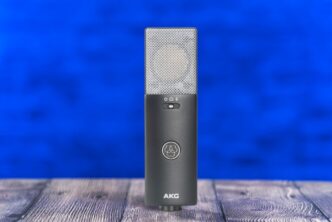
Visually, it borrows quite a bit from the C414 shape, which is not exactly a bad family resemblance to have. The satin-black finish looks clean and understated, and the recycled metal body is a nice touch without feeling like a gimmick.
The included mount is basic, and I would have preferred a shockmount in the box, especially for spoken word and desk-based setups. That said, cost has to be kept down somewhere.
Overall, the microphone feels solid, practical, and presentable enough for video work.
Who is the AKG C104 best suited for?
The AKG C104 is best suited for podcasters, streamers, singers, and beginner producers who want an affordable XLR condenser that sounds clean and mature without requiring much setup.
It is not the most feature-packed mic, and it will not replace a higher-end studio condenser for engineers who need maximum transparency or tonal depth.
However, for speech, vocals, acoustic instruments, and general home recording, the C104 offers a lot of practical value. If you want a simple cardioid condenser that gets the job done and does not sound obviously cheap, this is one of the better budget options in AKG’s current lineup.
See current price at: SweetwaterAmazon